Showing posts with label heguru. Show all posts

Celine, our first Hado Reader from Singapore

Thursday, October 25, 2018

The first Hado reader was born in Heguru Singapore at CitySquare mall in May 2018! The first in Singapore! And read this: she is only 9years old this year! Mindblown!

In order to qualify, you will need to read 10,000 books in a month! I don’t know about you but reading one book a month is challenging enough for me! With 10,000 books a month, you will be able to join the Ichimankai Club in Japan, which has trained many who have topped their classes and passed the entrance test for Tokyo University. 

Celine Ong is only 9 and has achieved this feat! I am so impressed! 


SO WHAT IS HADO READING?


It is a form of right brain function where individuals with that ability are able to rapidly absorb information from any book.

Hado reading is developed by Heguru CEO Ruiko Henmi. In 1997, Mrs Henmi invented the epoch-making technique, the first in the world, of how to read a book and understand its contents, just by turning over its pages. It is claimed that Hado reading surpasses even speed reading. This concept seems preposterous but it is really true that one may be able to understand the contents of a book within a single second. To achieve this, one has to commence their training with the Heguru programme at an early age. Guess I might be too old for that!

Hado reading is not to be confused with speed reading. Hado does not read words in the book. It is the catching of information written in the book with the right brain. In other words, the brain is picturing things. Speed reading is the ability to read written words with speed. You may be reading but you may not be comprehending. 

Every child has a sleeping talent and at Heguru, they feel it is their mission to draw out that talent! The talent to hado read is so useful for a child as he will be able to study in an extremely short time. As a result of parallel processing skills, children can learn arithmetic, reading and Social Science simultaneously. The Hado reading segment is part of Heguru’s Primary Programme. I can’t wait for Big K to experience that! Yes she is 7 this year and technically she should be in the Primary class. However, due to her long hiatus in right brain training, the trainers and I felt that given her character, it is better to warm her up at a preschool 2 level. This is the level where most kids are 6years old. There is no shame in it as Heguru and I both share the same vision and that is for them to learn at their pace, in a happy environment.

The below vid further validates my decision.


So scary is the pace of the class! Big K takes a lot of time to warm so such a setting may be intimidating. In fact, during her first few weeks, she was a little taken aback. She couldn’t really catch up and was very disheartened. However, the environment was really nurturing and encouraging and within a month, she was asking for more! She was constantly rushing me to be early for class! That’s genuine enthusiasm if you ask me. In terms of work, she caught on really quickly and has progressed by leaps and bounds. 


The feedback i was given at the start was that she was adapting well and 95% of her work was accurate. At the most recent parent chat session, her trainer was proud to announce that Big K has opened up and shouts out the answers in class. She is also able to able to remember more numbers under the number memory activity and the lyrics to a song that was taught last month. The fact that she was shouting out the answers with gusto reassures me that Heguru not only has trained her right brain but it has also trained her in terms of confidence. Back at home, she would badger for her Heguru homework. She doesn’t mind doing 10 pages at one shot! THIS is true love which has been instilled by Heguru.

People often ask me if this will really make their kid smarter. Well honestly I don’t know but i am seeing results. Seeing my child pick up skills which will help her go a long way in life is good enough for me. Anything else will be a bonus. I will be sharing with you more on her progress progressively, so stay tuned!

Why did i enrol my 7 year old in Preschool Heguru?

Saturday, April 14, 2018


Big K turns 7 this year! Gulp! Did i say 7? Yes, another milestone has been achieved as she blazed into primary school. Currently, she is coping pretty fine at this level but i know that she has much more potential and that she is always taking her own sweet time when it comes to completing a task. No more spoonfeeding and nurturing like in a preschool. She has to face reality where things are fast paced, like it or not.

Since she was about 20 months old, she had been enrolled in an established right brain school. She was there for probably 2 terms but i got pregnant again and had to stop. It was way too tiring for me to carry her for lessons with a big tummy of mine. It was parent accompanied and sitting in class with her, trying to pin her down onto a chair, behind a small table, was quite a feat. My extremely patient dad tried once and he came out telling me never to ask him do such a thing again! It was not that she is a terribly active child. In fact, under normal circumstances, she isn’t. She is reserved. But somehow, during lessons, she would wander from one end of the classroom to the other, distracting other kids. There wasn’t any physical segment to expanse the kid’s energy hence making sitting down throughout a little challenging. As such, she holds the title of an Indian chief and all other toddlers would follow suit. If i could, i would dig a hole and bury myself there and then. The teacher assured me that it wasn’t that she wasn’t paying attention but she was and that probably already knows her stuff! Wow! Are you serious? Do you mean I’ve got a genius here?

Fast forward several years later, after seeing how right brain training at Heguru is doing Small K good, I decided to let Big K have a go. Due to her long hiatus from such training, i decided to start slow and after speaking to Principal J, we decided that Big K should start at a Preschool 2 level. According to her academic age, she should be at the Primary level, but at Heguru, it really is about the process which they are trying to mould.

Details on Preschool 2 program

Duration: 90 minutes
Child's age: 5 to 6 years old
Number of classes: 42 per year

Highlights of this programme:
  • Enlarging the brain capacity and achieving connection between the left brain and the right brain.
  • Nurturing high-speed processing skills.
  • Nurturing the power of expression and ability of comprehension.
  • Promoting cooperation through group interaction activities.
  • Further development of the left brain and enhancement of right brain power through the use of prepared worksheets
This programme is designed to effect a superb balance between the right brain and the left brain. With lesson lasting 90minutes, it helps their concentration powers to flourish. Moreover, cultivation of the left brain will be at a higher level than in previous classes, so a foundation is built for the children to utilise when they become primary school pupils. This foundation is absolutely necessary to let their right brain bloom at primary school. 

Big K’s thoughts
The initial start was tough. It wasn't about the brain training but she hated the idea that she had to wake up early for a weekend class while her little brother got to spend time with me. Small K still had the luxury of going for a weekday class back then you see. In addition, she wasn’t used to the fast pace and the due to the small enclosure, she was a little disturbed by the voice of the trainer reverberating. It was thunderous as she put it. Coming from a very nurturing preschool, she was always pampered and wasn’t used to such settings. Welcome to the real world, baby! It is cruel and education in Singapore is rigorous.


A month into the lesson, she wasn’t complaining as much and would hurry me for class as the early birds got to sit on chairs and according to her, that cushioned the voice a little. I’m glad she figured a way out. Today, 4 months into the programme, she is looking forward to her lessons every week and would in fact ask incessantly if there was going to be lessons that week. It does help that now the little brother is also going for a weekend class at approximately the same time.

Homework
Right from Preschool 1, the children will be assigned homework. Yes, you heard me right. Homework! Students are given three booklets during lessons. One (Booklet C) to be used during class, another Booklet R, where the questions are more or less similar to those done in class to be used as revision, and lastly Booklet H which is the homework booklet to be handed in during the next lesson. At the beginning, Big K needed quite a bit of handholding. It wasn’t that she didn’t enjoy doing it. On the contrary, she looks forward to it and would badger me to let her do them over my ‘activities’. Ok Heguru, you win! However, there were a few visualising questions which were rather challenging and I had to make use of manipulatives to assist her.


Due to her prior training plus the games we play at home, she caught on rather quickly and right now, i simply assign her a few pages and she will do them all after school each day. Most of the time, she goes beyond and attempts more than required! This is such a motivation as it clearly shows that the child is enjoying every bit of it. It is with much regret that every week, we are only able to complete booklet H and not able to attempt booklet R which we should, for reinforcement. Should we still be in Preschool where time wasn’t so tight and there were minimal homework, we would probably do them all. 

Mummy’s thoughts
I love it! Anything right brain is fascinating for me right from the start! We all know that the brain is divided into the left and the right. The right brain is able to absorb, at high speed, large amount of information. At a Primary level, students will master Hado reading which works on instantaneous memorising. Sounds unbelievable i know! When I saw the promotional video, my mouth was agaped the whole time. I was in disbelief but it has been tested and proven! In Japan, where their headquarters are, if you read 10000 books a month, you will be able to join their Ichimankai club. With consistent training, students are able to draw out their inner genius and be in special education, top their class and pass entrance exams for Tokyo university which we know is quite a feat.

See below video and be enthralled:


I shan’t deny, I do harbour thoughts that one day, my children will reach this stage. Who doesn't want a bright child right? But i know it takes a lot of consistency and discipline to achieve. And sadly, given the current situation, my hands are pretty full. 

When i first saw the programme outline, i was ecstatic.


There were a lot of visualizing involved which is extremely apparent in today’s test papers. Here are some examples taken off 2017 Primary 6 Singapore Chinese Girls' School Math paper:


Education has evolved in such a way that questions are no longer expressed in a straightforward manner like in 1+1. Rather, it now involves a lot of higher order thinking from the child. Not easy. Not easy at all. Even for an adult, it isn’t easy. Students cannot learn such things through rote learning. You either ‘see’ it or you do not. With such exposure, I believe it will value add when the child is faced with, for example, Math questions on the topic of Circles where students have to use the cut and paste or overlapping method. Something which requires visualisation. Let’s not even go so far. At Primary one level, the Math syllabus includes shapes and patterns. The exposure from the various Heguru puzzles like the pelican puzzle, magic cubes, tangram and plate puzzles would definitely aid visualisation. 

An example of one of the puzzles used during lesson -- Magic Cubes


Another puzzle -- IORITA


Tangram
The part which i particularly like is the energy in class. Students will participate enthusiastically, shouting out the answers the moment they have completed. The time limit for each activity is typically 60seconds. This is an excellent way to push my little one who, since young, has no sense of urgency and is way too meticulous for my liking. In other words, Slow. Why rush the child you ask? Well, if she keeps up with this nonchalant attitude thinking that she has all the time in the world and that the world will stop just for her, sorry baby, but you wouldn’t survive the vigorous system. This is especially apparent where students need to complete 30 question Math questions in 50 minutes in Paper 1 and 18 gruelling Math problem sums in 1h 40mins for Paper 2 during the Primary 6 examination. It not only tests on speed, but understanding and stamina. Society is cruel.

On average, each Heguru activity has to be completed within 60 seconds while in class. This trains the child on speed. It is not about getting the right answer but rather the process and the willingness to try. Big K has an avoidance issue. Whenever she isn’t confident of something, she will not attempt in front of you. Typical of most kids I think. That said, when you are not looking, she can be often seen practising hard, trying to perfect things. A perfectionist, this little one. Wonder where she gets this trait from. 😅🤔

On stamina. Children in general lose focus easily. I mean an exam paper is on average 2.5hours. Expecting them to sit down throughout and focus is really intense at a young age. They do not have stamina and some may be deemed as being ADHD etc. Society has coined so many new terms that for everything a child can or can’t do, there is a psychological explanation which i am honestly skeptical of. 


Kids are like animals and they can be trained. Likewise, for stamina, at Heguru, they train it through various activities. One of which are featured above.

I have recently attended their parent preview for the Primary Programme and am tremendously inspired and motivated that this is the right course for my children. However, the jump is rather huge for Primary as the class can hold up to 40 students. Imagine a huge class with everyone shouting the answer out in less than 60secs. Big K isn’t ready for that transition so her trainers and I have decided to go at her pace and for her to get accustomed to the preschool system first. To build her confidence and allow her to grow. Child-led — in line with my motto. 

In my next installment, i will share with you in more details, what are the various activities done at a Preschool 2 level. 
So stay tuned!


Do also follow Heguru Citysquare mall on Facebook or check out their website for more details. Do give them a buzz to book your slots or speak to their friendly trainers for further insights!


Disclosure: We were invited by Heguru CitySquare mall to review their courses and attended complimentary lessons in return. All opinions expressed are entirely my own and written according to my experience in using the products/ services.


Review: On to the next stage at Heguru

Sunday, December 10, 2017

In a matter of weeks, Small K will be embarking on a new journey with Heguru. As if having Big K en route to Primary school isn't emotional enough, now they are telling me that my younger baby is being promoted to the independent class! Meaning, mummy need not sit with him in class anymore! GASP! Cue: Cry. Time really needs to slow down!

Heguru has several classes:
1) Infant toddler class (for toddlers aged 6months to 3years old)
2) Preschool class (for children age above 4 years old)
3) Primary class (for 6 years old and above)
4) Hado reading (I will talk more when we get there)


This was my baby when he first started Heguru! OMG!!!! Where has this baby gone? I. just. cannot! The shirt is now a little tight and the pants a little short. The shoes can't fit him anymore and I am pretty sure his brain is expanding exponentially!

So Small K will turn 4 in 2018, hence he will move on to the preschool class. Heguru does not necessarily promote a child just because of his age. They do see if the child has made such a progression. For example, we had a classmate from China who just joined us and even though he is ready for the next stage, age wise, he will still remain in the infant toddler class for a term or two, lest the shock be too great for him. I appreciate this as I have seen certain enrichment centres who push the student up to the next level just because it is time. 

Small K has been attending Heguru on a weekly basis for about 1.5years now, below are some things which I have noted of his progress:

1) Flashcards
At the very beginning, he wasn't too keen in flashcards. He fidgeted a bit. I was a little worried but the instructor assured me that sometimes it may be because the child already knows the topic hence is reacting this way. Give them some time and they will be all good. So each time the segment Super Flash came along, I bounced him on my lap, in sync with the rhythm. This worked! He thought it was fun! Now, I no longer need to bounce him. At a young age, the child lacks discipline hence it is up to the parent to instil it into the child. That is also the reason why the infant toddler class is an accompanied one. So that parents can go home and practise what they have learnt in class with the child. Once they are used to the system and routine of things, everything will fall in place and they are better equipped to enter the preschool classes. At home, Small K used to run away each time I ask him to do an activity. However, these days, he is able to sit through. Especially if the sister is also doing "homework" for me. Many mummies have shared that it is a boy thing. That they will run around and not sit still. However, I hope that Heguru can "tame" him. 

2) Memory
This is one aspect where I think Small K has shown significant progress! Linking memory together with peg memory are primarily the segments to train children's memory. For linking memory, the instructor will place a series of picture cards and narrate a silly story to link them up. Each child is also then given three cards to make a story with. Small K now not only is able to shout (ok, say) out the three cards that he has (without prompting), he is also able to verbalise some other cards in the story. I believe he remembers more than he says. His memory is also evident in our everyday life and I find his observation skills excellent, probably due to the fast pace of the class.

3) Number memory
I had been trying to get him to remember the last number of each line. So far, he is able to. However, there were several times when he refused to cooporate and help me with memorising the numbers. Hence, I had to rely on my old brain! There were many occasions where he was also able to remember more than one numbers. This further validates that his memory is developing very well. 

4) Dot bar 
The dot bar system is essentially teaching little children addition and subtraction. All this while, I have been going through the motion of repeating after the instructor. Never had I expected that one day, Small K decided to shout out the answer to 3+1! A simple sum to most but for a 3 year old, I think it is quite a feat. To be honest, even though I do activities at home with him, they are mostly fun stuff. I do try to incorporate elements of Math, English, Chinese and Science however, being a second born, he is often shortchanged. Mostly, I would pass him a tub of playdoh and he would be entertained for minutes. So when he was able to shout out the answer whenever the instructor says out the equation, I was impressed. It all came naturally. 

5) Abacus training
I noted his interest in this gadget when he was playing with a smaller abacus at the play area. While other children were busy with train tracks, this boy took more interest in pretend play and the abacus. I didn't think much of it but took out the abacus we had bought some time ago. I left it aside and one day, I heard Small K reciting the 10 times table! 10, 20, 30, 40..... Towards the end he was a little shaky, but this is still a moment to celebrate! 

6) Mandala
Mandala is an activity where the child is given a few seconds to view an image filled with colours and then mark down the colours on their empty set. Most of the time, this activity is done by the adult. And even for an adult, it is challenging! Of late, Small K was able to independently mark down some colours accurately! Albeit a little slow (we are only given a few seconds to do that), it is progress nonetheless. Hopefully when he progresses to Preschool class, he is able to work faster with peer pressure.

7) Dancing & Singing
Ok, this is definitely lacking in Small K. I'm not sure why, but it is difficult to cajole him for a dance! He can be dancing and singing non stop at home but somehow at Heguru and school, he is hesitant. Not that he doesn't enjoy. You can see the twinkle in his eye. He really wants to do it and join in the fun, but somehow, he still has his reservations. Slow and steady baby, mommy isn't expecting you to be a dancer anyways. 

8) ESP 
This is a pretty bizarre segment which I was skeptical of at the beginning. How is a child be able to see through a card and guess what is the picture behind it? How is a child be able to know what I am thinking of? Apparently I have heard several success stories and it is beginning to show for Small K. I honestly don't think getting an answer right 8 out of 10 times is attributed to purely luck. You can't be that lucky all the time right? At times, the moments when he got the answer wrong is because he was choosing the picture he likes rather than what he "sees".

9) Iorita & Tangrams
This must be Small K's forte. He does it with ease, using both his left and right hand. Apparently, we should be encouraging that as it is working the left and right brain. An important skill for future learnings. Many a times, even though it isn't a competition, Small K would finish the task first! So proud of my baby!


It is interesting to note that Heguru gives a 5 minute debrief to parents after class. They will suggest various activities for parents to practise at home with the child. They also put up the list of things they aim to do on a monthly basis. Things are very transparent and I feel as a parent it's important to know how to help our child further.

Below is a video summary of some of the activities done during lesson. There are more, but it's so fast, I couldn't record all down! 


Many a times, I am hit by mummy guilt for leaving my secondborn to his own devices. I do not teach him his ABCS as much and am not even as hardworking in the areas of homelearning as compared to the times when I only had one child. It is tough to juggle especially with work. The late nights sucks me dry. So much so, I will always simply throw him a piece of paper and pencil for him to doodle. And we have to balance it with outdoor play as well! But he surprises me every single day. Hence, I am really thankful for the exposure Heguru has given Small K. Given the lack of supervision from me, it seems that his outputs are primarily due to Heguru and school. 

A more recent photo of my baby and Teacher Mandy, who is always so cheerful and patient! Look how much he has grown! *emo again.
There are going to be slight changes from the toddler class to Preschool 1 class. For one, the duration will be slightly longer. From 50 minutes to 70 minutes. I do not think this will be an issue since he is often engaged during the lesson. He will start to be more independent and do more worksheets. Something which I like to instill lest he distracts his sister who is moving on to Primary school next year. I am sure going to miss accompanying him for lessons. I can't believe how fast my baby has grown. Let me bask in my emo state for a bit here. *sobs

To find out more about how Small K progresses at a preschool level, stay tuned in 2018! Do also follow Heguru Citysquare mall on Facebook or check out their website for more details. They are now opened for registration for 2018, so do give them a buzz to book your slots!

Disclosure: We were invited by Heguru CitySquare mall to review their courses and attended complimentary lessons in return. All opinions expressed are entirely my own and written according to my experience in using the products/ services.

Review: Activities at Heguru Part 2

Thursday, March 2, 2017

Previously on my review on Heguru here, I shared with you some of the activities we do during class. As there are a gazillion activities conducted at such fast pace, it is impossible to squeeze all into one post, hence, as promised, here's part two.

Photo credit: Busy Teacher


Many people are mistaken that right-brain training is just all about flashcards. Many are skeptical as to how flashcards can help a child. I'll be honest with you. I was skeptical too. For example, initially I did not know why they are flashing flashcards of over 20 colours. I mean a red is a red, what's with telling me merlot, mahogany, crimson, garnet, scarlet, sangria...ok, you get me. However, I soon learnt that when children see and hear the names of different colours and shades, their sensitivity for colours will start to develop and also improves their vocabulary for colours. This will help stimulate the child's subconscious and increase the variation of colours. The flashcard method is also validated as a method for developing photographic memory. Many do not know that what they are trying to do is to input as much as they can during this sensitive period so that the child will output with ease in time to come. We aren't expecting them to be Einsteins overnight. Sensitive periods are special. It is in these phases that the child tries to tell us that they are deeply fascinated about something. Every child is unique and their sensitive periods may differ. However, it is usually below the age of 6 where the thirst for knowledge is immense. 

Writing & Motor Skills


As you can see, Heguru is not all about right-brain training. They recognise that both sides of the brain needs to work hand in hand to provide a more holistic training. I am very glad that writing and motor skills training is incoporated. Particularly the tracing of letters. Being my second-born, Small K has been greatly shortchanged. By this age, Big K would already be able to tell me which letter is what and what begins with the various letters of the alphabets. So, I am immensely grateful that Heguru has this segment which trains children in letter recognition. This reminds me of the sandpaper letters which Montessorians like to use. It really does help in letter recognition. At age 2-3years old, we can also guide our child to write words. If they are unable to write words yet, you can do the following:

1) Show the the flashcard of the word
2) Have them pick up the cards
3) Have the to say out the words on the cards

It is important that we gradually build on their output abilities by guiding them to write. 


Craft Work


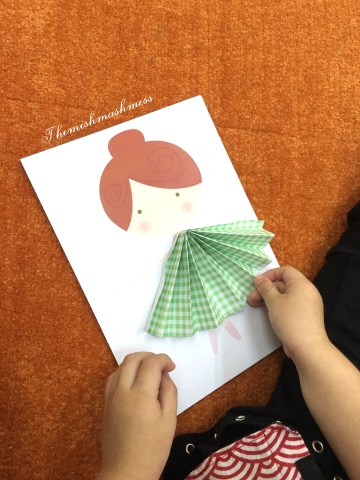
All work and no play makes Small K a dull boy. Often, during the lesson, there will be something for them to make. It could be a little skirt as above, or a paper plate crown, or Origami. Do not underestimate such craft work. The benefits of say Origami is immense. The brain stimulation that origami supplies is plenty enough to get your cells moving even at older ages. It also enhances three-dimensional thinking, non-verbal reasoning and patience. When doing so, you activate every skill each hemisphere controls as well. 

Phonics


It was rather interesting to see the above activity introduced. In my mind, I was thinking "Aren't they a little young for this?" But hey, they are in their sensitive period, so just input!

Music Appreciation


I have been nudging myself to introduce music proper to the kids. Being previously trained in piano, I feel I am the best person to guide them through the beginning stage. Unfortunately, I have made painfully feeble attempts. At Heguru, the children are introduced to music and their different composers; solfege (listening to the tone of a note and knowing the various semibreves, minim etc) and recognizing the sounds of different instruments. 

Encyclopaedic Knowledge


This segment on attaining encyclopaedic memory is really interesting. Children are exposed to several concepts way beyond their age. The aim here is not for them to know their periodic table overnight, but to assist them at outputing in the future. Children absorb knowledge like sponges. The focus is not mainly on the mastery of encyclopedia knowledge alone. For information is expanding geometrically and hence it is just impossible for you to teach your child to master all of it. Through such exposure, we are nurturing the child to develop a desire for continuous learning and the skill to master new information. 


三字经


The teacher in our preschool has lately commented that Small K doesn't seem to know how to speak in Chinese. Well, not that he doesn't know, but more of he doesn't want to! This is probably due to the lack of exposure to the language. As such, I am glad that heguru does blend in other languages when teaching. On top of poems, they learn through songs as well as flashcards. This benefitted Small K a lot as at a tender young age, he was able to recite the 唐诗。

The Alphabet Song


Right after exercise time, when we will go out of the classroom to pass or kick a ball..or hop on one leg, the kids will be back in class to sing the alphabet song either in English or in Japanese. Small K is particularly intrigued when the Hiragana song is played. 

Story Time


This segment is often the kids' favourite! Everyone simply crowded round the facilitator to listen to the story. Teachers as well as parents are meant to inspire our children in their lifelong learning journey. And I can see the passion and sincerity shown by the teachers at Heguru. As a facilitator, no matter how playful the child is, they do not criticise or shout at the child. After all, shouting doesn't make things better. Apart from raising one's blood pressure, it causes one to lose a sense of what's really happening. Instead, they speak from their hearts. This is something which even I am trying to learn. I have witnessed myself losing my temper so very often this year. Particularly at Big K. Probably because she is entering Primary school next year and knowing the rigours of the education system makes me worried. Not that she isn't a bright child, but I know that we have lost precious time last year from shifting house not once, but thrice! So when she fails at meeting my expectations, I sometimes raise my voice and question her why. Parenting and teaching don't come with a manual. No one said it was gonna be easy. Heguru not only teaches my child, it trains me to be a better parent. We as parents should mind our words as we are role models for our children. We should take every night to reflect. 

I am learning. Are you doing that too?

Follow Heguru Citysquare mall on Facebook or check out their website or more details! They have regular parents info sessions, so do give them a buzz to catch a lesson preview!

Disclosure: We were invited by Heguru CitySquare mall to review their courses and attended complimentary lessons in return. All opinions expressed are entirely my own and written according to my experience in using the products/services.  


Review: Activities at Heguru and how to conduct home practice

Saturday, October 29, 2016


Did you know that to encourage creativity in children, you could draw with your eyes closed/ draw with your non-dormant hand/ encourage your child to be bored/ daydream/ engage in word games? Well, those sound simple enough but to go a step further and to stretch that right brain, we have been attending Heguru at Citysquare mall. A centre which encourages right brain training. I believe through such training, I am igniting creativity which will be useful in his future. Right brain education opens neural pathways and it is best to be completed by age ten. Through this programme, I am not hoping that my child will become an overnight genius but the constant inputting will enable him to absorb new information quickly and easily. This has been quite apparent from my observation of Small K who is like a sponge! During each lesson, there would be over 30 activities done. Excellent deal to condense the week's worth of learning into just one lesson isn't it? Something which, if left to me, would not have been achieved in a mere 1 hour. I will be sharing with you the activities in two parts. There are simply too many to squeeze into one post! I will also share with you how we DIY at home to complement our right brain training. After all, the child would benefit more if we are able to follow through with home practice. So without further ado, here are some of the activities: 

1) Math
What's included: Abacus; Dots Programme; Multiplication table; Addition Table; Dot Bar; Nummer Kaisten; Number memorisation; Perfect Intuition 


The Dots programme introduces the concept of quantity and sequencing. We are familiar with some aspects of this. The Dots programme is very much similar with The Shichida 63 Dots programme and the Doman Method of teaching Math. They all have the same rationale which is that it is to help he child in mental calculation using dot imaging or intuition. Back when Big K was about 3yo, I had used this method and was pleasantly surprised by its results. We are able to conduct this training at home back then using pre-packed cards and was supposed to do it every single day without fail. However, as a busy mom, most would know that this isn't possible and we would end up missing some days. Hence, I am really thankful that the dot programme is included in Heguru and that Small K is able to benefit from it. 


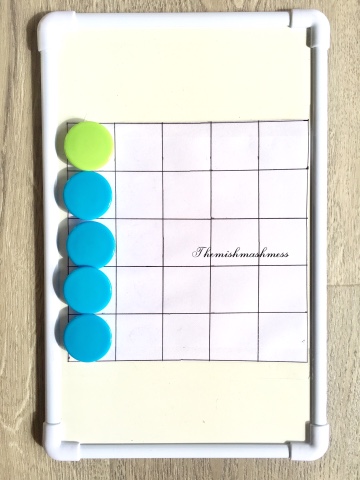
The Dot Bar is another aspect of Heguru which is unique. This is used to complement the Dots programme. Each time, the trainer would demonstrate a few concepts like addition and subtraction using grids and dots. As we are in the toddler class, typically a 3 by 3 grid or a 5 by 5 grid would be used. 


I managed to DIY something similar at home using a magnetic board and round magnets bought from Daiso. 


The Nummer Kaisten is an in-house manipulative which allows children to learn mental arithmetic in a visual way. Concepts of addition and subtraction is demonstrated here.


Abacus training is used at almost every lesson. At this stage, the giant abacus is used to teach the child how to count. From counting in ones, to counting in tens, the abacus is a great tool to capture attention. In fact, Small K loves it so much that I frequently caught him "teaching himself" using the small abacus we have at home!

Number memorisation
At the very beginning, this is my most hated activity. Yup! You heard right! I actually dislike something in the class! Why? Because sleep-deprived mommy here has to be attentive and try her best to memorise a string of numbers in a mere few seconds! I found it really tough to recall a long string of numbers, but strangely, after a few terms of training, I actually found myself pretty good at it! Acing it most of the time! So how is the child involved for this activity you ask? We basically have to whisper the number to the child. In time to come, the child will use his peg memory (which will be discussed later) concept to link up with the numbers and be able to recite them out. For now, Small K has wowed me by being able to say out the last digit once in a while. He isn't able to write out the numbers as yet, but I think to be able to say out the last digit, whether it is by a stroke of luck or not, is amazing!


Apart from the above, Heguru also strives to introduce concepts like mass, volume and density through interesting experiments. At a young age, children are inclined to learn visually, hence, such presentation of concepts will benefit the child tremendously.

2) Flash cards


Super Flash
Young children have a natural love for learning and they absorb like sponges. This is why over at Heguru, there is a segment called Super Flash. This comprises of more than 15 themes each time. Don't ask me for exact figures, because things happen so quickly, I can barely keep up! This works out to approximately over 400 cards flashed each time! Some examples of the themes include: amphibians, hazard symbols, flower arrangement tools, flags, types of dresses, types of chairs, Numbers 1-10 in Hungarian; types of burrowing animals; bones and so on. I am a strong believer in this and have a great volume stashed in my cupboard. Mostly were homemade by yours truly back in those days when I only had one child. They really aren't that difficult to make. We just need time. These days with the advent of technology, I can even do them on my iPhone! Once home, all I need to do is to proofread and send to print. The painful part is cutting them into A5 size which even then, isn't too big a deal with a cutter. 

Benefits:
So what are the benefits of Super Flash? 
  • For starters, it is great to input as much information to the child. Even if it seems too advanced at this moment. In the future, when he/ she does touch on this topic, it will somehow be easier. 
  • High speed flashing of cards activates the right brain, needless to say and will develop the child's photographic memory function. This is especially important before the age of 6, after which, right brain development will see a dip. The cards are all picture cards and as far as possible, they try to use real life images. Names of the pictures are verbalised at the same time, hence helping to create a connection between both the right and the left brain. The left brain would process language whilst the right processes images. Don't worry if the child is not paying attention. Take a break. Even if he is moving around, he is absorbing. The strange thing for Small K is that he sits attentively at Heguru, whilst at home, he is always monkeying around! 
How to DIY?
  • Decide on a topic and start googling for pictures. Have them printed out on A5 cards, preferably of 300gsm. The words should be printed behind so as to facilitate flashing. I used to laminate my cards (adding to the time and cost), however, I realised that if I use a thicker cardstock, it would go a long way too. Furthermore, by laminating, at certain angles, there may be reflection which may not be good for the child's eyes.
  • To flash, one needs to be fast. The teachers over at Heguru are all professionally trained and examined. 1 second per card is preferred.
  • As many topics are to be covered each time and the same topic should not be repeated twice at a time. It can however be repeated on a daily basis, but to prevent memorisation, the cards should be shuffled and changed after 1 to 2 weeks.

Apart from Super Flash, flashcards are also used to teach words in both Chinese and English. There is also a segment called the Encyclopaedic Baby Programme where flashcards are used to teach things like ordinal numbers (1st, 2nd, 3rd)  This is complemented with songs and manipulatives used by the assistant teacher. 


3) Photographic memory
Linking Memory; Peg Memory; Chic Chak Time; Spatial Memory; Mandala

Once a child enters Primary school, it is a constant challenge to cramp as much information as possible, in the shortest possible time. Therefore, it would be great if the child is equipped with techniques which will help him in memorisation.


Peg Memory
This is a system of associating numbers to images. For example:
71 - Nun
72 - Shampoo
73 - Cemetery
74 - Store
75 - Housewife
For a few weeks, the child will be taught ten peg numbers before moving on to the next ten. In order to help the child with recollection, a silly story is made. For example: I saw a nun put shampoo on her hair at the cemetery.

Below is how we DIY. I managed to find a printable over at mummyshymz. I have yet to complete cutting as you can see, but we'll get there!


Linking Memory
This is more random. Picture cards are presented and the trainer would narrate a story to connect the pictures. This is a method which even the cave men used! The story doesn't have to make sense. In fact, the more ridiculous the better it is. Put things in unbalanced positions and don't be afraid to make things do what they don't usually do, e.g. A pig flying over the sea. The class would then each use 3 cards to form a story. You can't expect to develop an extraordinary memory overnight, but by learning useful techniques and learning them periodically, one can be more proficient in it. 
The key to linking memory is to use your IMAGINATION and PRACTISE!

Below is what we use at home to aid linking memory:
photo credit: http://owlissimo.com

Mandala
While most of the time in class, it is the me who is doing all the memorising and Small K is the one who is doodling, it is it is great that he is participating. In fact, when practising at home with fewer colours, he is mostly able to get them right most of the time!


At home, using the Everyday Mandala for Children series


This activity can be done on the go too! While I don't advocate too much screen time, I do allow the kids to have a bit of exposure on weekends. So, rather than watching senseless cartoons, this, is a great alternative! Some apps to consider:

4) Physical Activities 

All work and no play makes Jack a dull boy. Heguru recognises that children need to let their energy loose. At around midway through the lesson, we will go out for some physical activities. These activities varies but the overall aim is to train the child's gross motor skills. This is vital for the child's development and lays the foundation for a healthy life. Physical activities establish connection between different parts of the brain. Whenever Small K hears the song to indicate the start of physical activities, he would be like a horse losing his reins and charge towards the door.


5) Puzzles
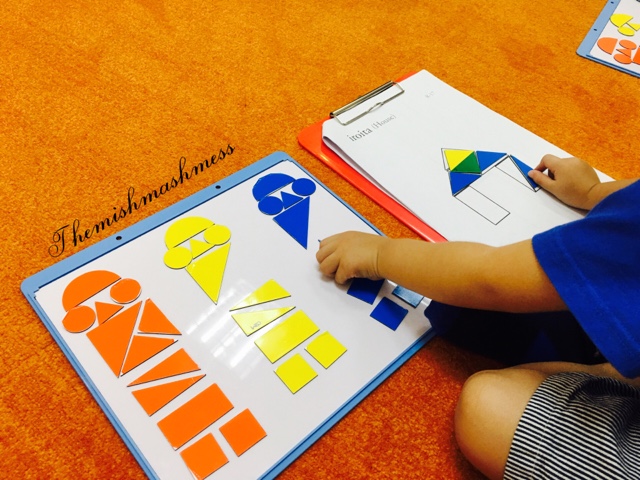
Iroita; Tangram


This is a favourite with Small K! Puzzles are great for cognitive development. When the eye sees the puzzle, it sends images to the brain which envisions and translate to the hand. The hand will then manipulate and get the right piece to fit. Both Iroita and tangram are pretty much the same which works on shape recognition. This is an important part of a toddler's development. Order of recognition for children includes:
  1. Colours
  2. Shapes
  3. Sizes
  4. Numbers
  5. Amount/ Quantity
  6. Spatial recognition
  7. Comparison
  8. Order
  9. Time 
  10. Money


Thrifty me wanted to replicate something similar and I did! All for a mere $8 vs a retail price of $49.90 (jaw dropped)! All materials obtained from Daiso. Am mighty proud of myself!


I am really impressed that Small K is able to identify and fit the shapes in so accurately. I haven't quite taught him shapes officially so he definitely picked up this skill over at Heguru!


For any form of enrichment, I believe that it isn't overnight success which we would see. It's through constant drilling and hard work. Whilst hard work most of the time translates to mundane and boredom, I feel that right brain training at Heguru is really fun and keeps the kids and parents alike, on their toes. The fast pace of the lesson also ensures that the child would not be bored. I really love the vibe. In fact, most of the time, I might feel a little zombified prior to attending lesson, however, the moment I'm in the lesson, my adrenaline gets pumped. School in the 21st century is no longer the same. Right brain training starts young and dips when we enter Primary school as that is when left brain activities are predominant. Academic excellence is undeniable important and the paper-chase situation worldwide is real. Heguru Program, however, is not centrally focused on a repetition of academic specific practices for children. The real focus is the development of learning abilities in the children that they teach – fundamental concentration and endurance power, memory power, comprehension and application power amongst others. If a child is equipped with the right skill, he would find his learning curve a little less steep.  

In my next review, I will share with you other activities done at Heguru and also how you can conduct home practice. Stay tune!

Follow Heguru Citysquare mall on Facebook or check out their website or more details! They have regular parents info sessions, so do give them a buzz to catch a lesson preview! Also, Citysquare mall is having an education fair on 19th & 20th November 2016 during which Heguru would be one of the vendors participating. Do drop by to find out more about their courses!

Disclosure: We were invited by Heguru CitySquare mall to review their courses and attended complimentary lessons in return. All opinions expressed are entirely my own and written according to my experience in using the products/services.  


DESIGNED BY ECLAIR DESIGNS