Showing posts with label Homelearning. Show all posts

The Secret to Speed Math: Fun with Abacus

Sunday, June 9, 2019

As a child, I had always loved Math but something made me dread it -- The mental computation of huge numbers. Back in Primary school, my Math teacher used to drill us so much on model-drawing as well as mental sums, I became fearful of not being able to match up with the speed which my teacher had expected. Then one day, over on Channel 8, I saw a show teaching its audience how to improve mental calculations using the abacus! At 10years old, I was intrigued and glued myself to the TV every afternoon at 4pm, taking down notes on how to operate the beads. However, the explanations were too fast, the formulae were too many and I didn't even have an abacus to do a practical. Hence, I gave up.

Fast forward decades later, it was time for me to drill my kids in mental calculation. Big K aged 7+ is honestly not too bad in her Mathematics. However her bane was her speed at calculating. At age 6, she was so slow at even giving me the answers for making 10, I thought I wasn't doing it right. I did explore the possibility of introducing abacus then, but procrastinated as MOE took abacus out from the curriculum. A million thoughts ran through my mine: Was abacus deemed as useless hence the ministry took it out?


This was when I was introduced to Fun with Abacus. It is a school founder by Joy Tay, who started teaching abacus to the young by adopting syllabus from Taiwan. After a while, she created her own workbooks to fit the local crowdUsing her expertise as a certified Abacus Mental Arithmetic Trainer and her knowledge of the local education curriculum, Joy came up with the solution to help a child learn Mathematics during the challenging stages. She believes that a systematic structure in the teaching program not only help the child but also give parents and schools a firm foundation to assist in a child’s learning curve.

Below was a short interview I had with Joy:
Me: Why was abacus taken out of the curriculum? Is it still relevant?

Joy: Of course it is. It was taken out naturally because the school teachers had a million other things to handle and were short of time even for their core curriculum, let alone enrichments such as abacus. There are also many steps involved in abacus and it's tough for a teacher to be teaching this to a class of 40 young children. The focus will just not be there.

Me: How many years has Fun with Abacus been around?

Joy: We have been teaching for 15years, mainly at preschools. Hence, the relevance is still very much recognised.

Me: There seems to be different types of abacus. What's the difference?

Joy: Yes. Abacus has been around for ages. There are different types of abacus used in different countries. They vary according to the number of beads. Some with fewer beads may require more formulae.

At this juncture, Joy whipped out her abacus and explained to me. Fun with Abacus uses the one below, where you have 4 yellow beads, 1 orange bead on top and 4 yellow beads below.


After her explanation, I found that this type of abacus makes the most sense. Each bead represents a unit. Just like how addition and subtraction are taught in Primary schools.  Let me share with you my findings on an abacus used by another abacus school. Some other schools make use of the abacus which is divided into 1 bead (representing 5) on top and 4 beads at the bottom. For such abacuses, one will need to memorise many formula 口诀 in order to solve higher order addition and subtraction.


Photo credit: Kiasu Parent forum


For instance:
In a question of 7-4, the child needs to apply the 口诀 of "-4=+1-5" So the child is conditioned to first position the "7" (top" 1 bead down; bottom 2 beads up), followed by thumb up 1 bead (bottom) and flick 1 bead (top) up to derive the solution of such a simple equation. This seems redundant to me. 


However, in the 9 bead abacus which we are using, it makes a lot more sense as one bead represents one unit. When they do their vertical addition and subtraction in school, they will then see that both are parallel. With that, I was convinced that this was the school for us!


 Also, I had made a comparison with their worksheets. In another school, they actually made used of cartoon pictorial to represent the beads versus Fun with Abacus which uses actual circles. This allows less confusion for the child in future. 

PROGRESS OF BIG K


Big K being older, managed to grasp the concept really fast. Right after our first session, she was so excited that she insisted on doing her homework the moment we reached home. I was really surprised but glad that abacus could ignite her love for Math. In fact, midway through the term, our teacher felt that she was ready for the Anzan which will eventually bring her to mental calculation. Anzan is the Japanese method of doing Mental Math by using a mental image of an abacus.  No physical abacus is used. This has been part of the compulsory curriculum in Japan for many years until the focus on the use of computers in daily life came along. Subsequently, due to the increase in usage of technology, there had been concerns that the general population is losing valuable skills, hence in 1989, the Japanese Ministry of Education reintroduced it into their elementary school curriculum. With such history, it's not difficult to be inclined with the notion that we are becoming too reliant on technology to perform simple tasks for us. 


In fact, I have personally seen how using the calculator is part of a muscle memory for young kids. I witnessed a child aged 12, using the calculator for 1/2 + 1/2 and yet another, aged 16, reaching out for the calculator naturally, to tabulate 1+1. Muscle memory, thanks to the usage of calculators officially for their Math papers at Primary 5. Way too young if you ask me!


After less than 3 months of weekly classes, I noticed that Big K's ability to count fast is improving. Despite the fact that I know she isn't using abacus or Anzan in her mental calculations yet. I believe the course has ignited her love for the subject.


PROGRESS OF SMALL K


When it comes to this boy, it's a little trickier. At age 4, he is rather fidgety and unfocused. Especially when it came to abacus which were all beads beads beads, nothing but beads. It did however helped that his sister was in the same class as him. You see, different levelled students can be grouped together and still receive individual attention from the teachers. But of course, as far as possible, the level of the class will not be too varied and is also kept small with a maximum of 6 students for effective learning. I'm pretty happy to note that now, he is talking less and working more and his butt is always on the chair! His concentration span is definitely longer now!

Small K wasn't competent for the number bond for 10 but after a few short sessions, he was able to shout out the answer immediately. Getting him to do his homework wasn't too tough also as he deems the abacus as a toy. The only thing is during lesson, I have to constantly remind him to get more work down and to have less talk as he was really having a good time with the teacher. He has made wonderful progress and is in fact catching up on Big K fast and furious After a few months, he too, had been introduced to the Anzan. I was initially very worried as to how he would take to it. I mean there are now no beads! You will have to visualise it yourself! To my surprise, he was superb at it! So much so, I believe he will catch up with Big K in no time.

Abacus may seem a little dry to some, so the teachers at Fun with Abacus always try to incorporate an element of fun. For instance, while teaching the number bonds, to assist them in remembering how to make tens, they turn it into a clapping game and calls the corresponding number for the bond a "buddy". Small K found it cute and was most willing to practice with me. Occasionally they also played games.
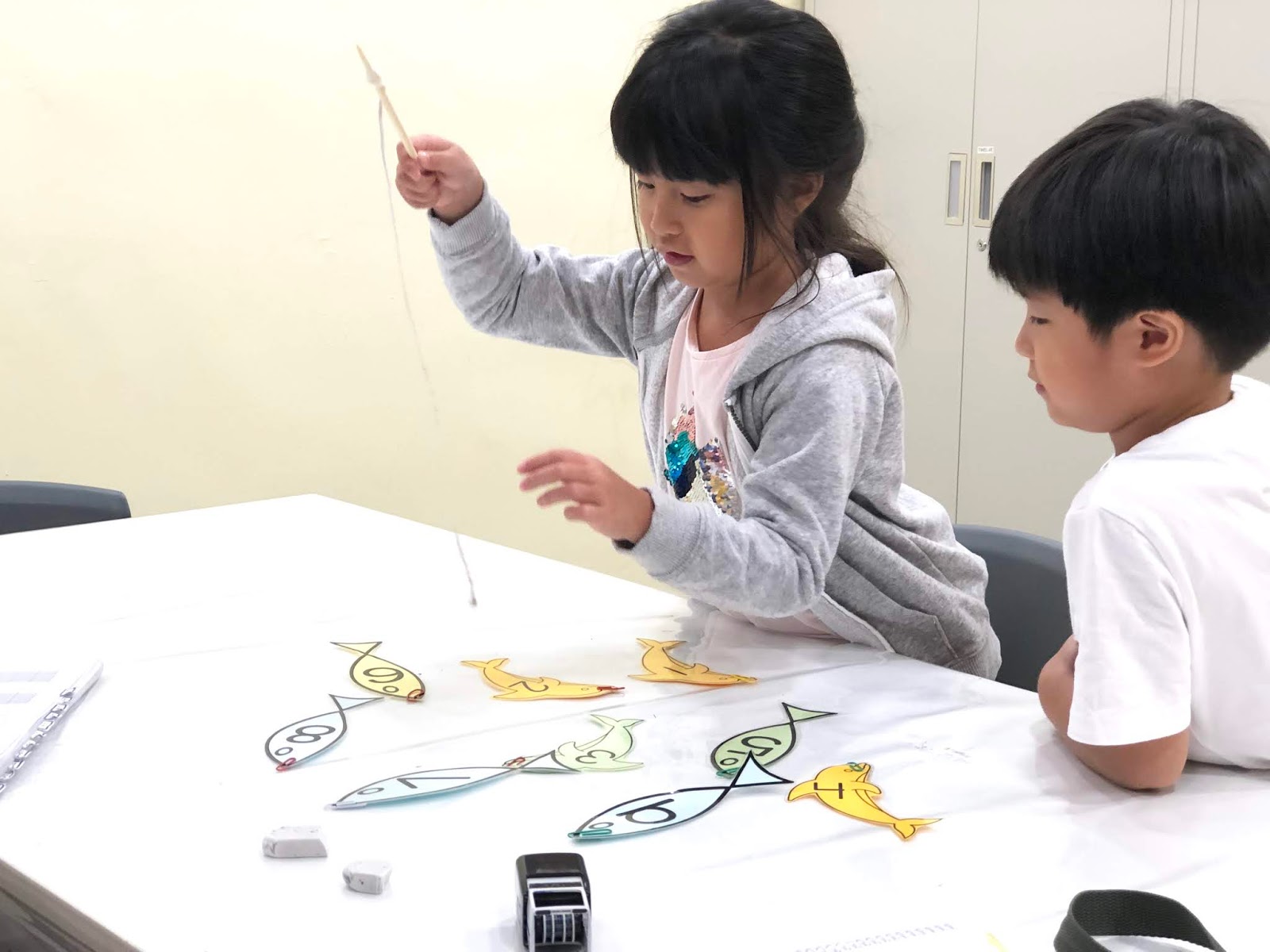

Here's Small K having fun fishing for the respective number bonds


At a certain level, the children will be given timed practice. Now this really excites Big K. She likes the adrenaline when she breaks her own record! They are each given a little timer to time themselves and hence, she can do her work independently without much help from me. Now that Small K is also getting the hang of doing his homework, he can also do most of the work independently. I just need to use eye-power on him.


Fun with abacus regularly sends their students for competitions overseas. Namely for the LCT Mental Arithmetic competition in Malacca as well as the International Mathematics Association Competition in Korat, Thailand. And these little brains all did very well! They managed to attain 1st to 5th placings for the respective competitions and they may be as young as 9years old! Hopefully one day, my little tots will be able to attain those standards too!

So with the advancement in technology, why am I still embarking my children on this journey. Well, the reason is simple, calculators and computers are all invented by mankind. It goes to show that the brain is far more superior if we tap on it. If we don't exercise it enough, it will go into solitude. While it is easy to reach out to the calculator in time to come, note that you are only allowed to use the calculator for Paper 2 at the primary level. Also, if the child is able to calculate fast enough, perhaps the time spent on fumbling with the calculator can be used wisely on solving other questions. Foundation in Math is very important in my opinion. It starts as young as when the child is in preschool or maybe even prior to that. If it isn't built well, trouble will start to surface predominantly when they hit Primary 5. By the, it may be too late to salvage. It takes time and effort to build. Similarly, abacus isn't a miracle pill. The child will not become quick in mental calculations overnight. It takes time and effort but I believe the rewards are real.


Fun with abacus accept children as young as 4 years old. Give them a call to check on their scehdule and head on down for a free trial and if you like it, Quote "JANICE WONG" and take $100 off their term fees.

Locations:
Katong Plaza
West Coast Centre
Seng Kang West
Bishan

or call: 97865383
Instagram: @funwithabacus


Why did i enrol my 7 year old in Preschool Heguru?

Saturday, April 14, 2018


Big K turns 7 this year! Gulp! Did i say 7? Yes, another milestone has been achieved as she blazed into primary school. Currently, she is coping pretty fine at this level but i know that she has much more potential and that she is always taking her own sweet time when it comes to completing a task. No more spoonfeeding and nurturing like in a preschool. She has to face reality where things are fast paced, like it or not.

Since she was about 20 months old, she had been enrolled in an established right brain school. She was there for probably 2 terms but i got pregnant again and had to stop. It was way too tiring for me to carry her for lessons with a big tummy of mine. It was parent accompanied and sitting in class with her, trying to pin her down onto a chair, behind a small table, was quite a feat. My extremely patient dad tried once and he came out telling me never to ask him do such a thing again! It was not that she is a terribly active child. In fact, under normal circumstances, she isn’t. She is reserved. But somehow, during lessons, she would wander from one end of the classroom to the other, distracting other kids. There wasn’t any physical segment to expanse the kid’s energy hence making sitting down throughout a little challenging. As such, she holds the title of an Indian chief and all other toddlers would follow suit. If i could, i would dig a hole and bury myself there and then. The teacher assured me that it wasn’t that she wasn’t paying attention but she was and that probably already knows her stuff! Wow! Are you serious? Do you mean I’ve got a genius here?

Fast forward several years later, after seeing how right brain training at Heguru is doing Small K good, I decided to let Big K have a go. Due to her long hiatus from such training, i decided to start slow and after speaking to Principal J, we decided that Big K should start at a Preschool 2 level. According to her academic age, she should be at the Primary level, but at Heguru, it really is about the process which they are trying to mould.

Details on Preschool 2 program

Duration: 90 minutes
Child's age: 5 to 6 years old
Number of classes: 42 per year

Highlights of this programme:
  • Enlarging the brain capacity and achieving connection between the left brain and the right brain.
  • Nurturing high-speed processing skills.
  • Nurturing the power of expression and ability of comprehension.
  • Promoting cooperation through group interaction activities.
  • Further development of the left brain and enhancement of right brain power through the use of prepared worksheets
This programme is designed to effect a superb balance between the right brain and the left brain. With lesson lasting 90minutes, it helps their concentration powers to flourish. Moreover, cultivation of the left brain will be at a higher level than in previous classes, so a foundation is built for the children to utilise when they become primary school pupils. This foundation is absolutely necessary to let their right brain bloom at primary school. 

Big K’s thoughts
The initial start was tough. It wasn't about the brain training but she hated the idea that she had to wake up early for a weekend class while her little brother got to spend time with me. Small K still had the luxury of going for a weekday class back then you see. In addition, she wasn’t used to the fast pace and the due to the small enclosure, she was a little disturbed by the voice of the trainer reverberating. It was thunderous as she put it. Coming from a very nurturing preschool, she was always pampered and wasn’t used to such settings. Welcome to the real world, baby! It is cruel and education in Singapore is rigorous.


A month into the lesson, she wasn’t complaining as much and would hurry me for class as the early birds got to sit on chairs and according to her, that cushioned the voice a little. I’m glad she figured a way out. Today, 4 months into the programme, she is looking forward to her lessons every week and would in fact ask incessantly if there was going to be lessons that week. It does help that now the little brother is also going for a weekend class at approximately the same time.

Homework
Right from Preschool 1, the children will be assigned homework. Yes, you heard me right. Homework! Students are given three booklets during lessons. One (Booklet C) to be used during class, another Booklet R, where the questions are more or less similar to those done in class to be used as revision, and lastly Booklet H which is the homework booklet to be handed in during the next lesson. At the beginning, Big K needed quite a bit of handholding. It wasn’t that she didn’t enjoy doing it. On the contrary, she looks forward to it and would badger me to let her do them over my ‘activities’. Ok Heguru, you win! However, there were a few visualising questions which were rather challenging and I had to make use of manipulatives to assist her.


Due to her prior training plus the games we play at home, she caught on rather quickly and right now, i simply assign her a few pages and she will do them all after school each day. Most of the time, she goes beyond and attempts more than required! This is such a motivation as it clearly shows that the child is enjoying every bit of it. It is with much regret that every week, we are only able to complete booklet H and not able to attempt booklet R which we should, for reinforcement. Should we still be in Preschool where time wasn’t so tight and there were minimal homework, we would probably do them all. 

Mummy’s thoughts
I love it! Anything right brain is fascinating for me right from the start! We all know that the brain is divided into the left and the right. The right brain is able to absorb, at high speed, large amount of information. At a Primary level, students will master Hado reading which works on instantaneous memorising. Sounds unbelievable i know! When I saw the promotional video, my mouth was agaped the whole time. I was in disbelief but it has been tested and proven! In Japan, where their headquarters are, if you read 10000 books a month, you will be able to join their Ichimankai club. With consistent training, students are able to draw out their inner genius and be in special education, top their class and pass entrance exams for Tokyo university which we know is quite a feat.

See below video and be enthralled:


I shan’t deny, I do harbour thoughts that one day, my children will reach this stage. Who doesn't want a bright child right? But i know it takes a lot of consistency and discipline to achieve. And sadly, given the current situation, my hands are pretty full. 

When i first saw the programme outline, i was ecstatic.


There were a lot of visualizing involved which is extremely apparent in today’s test papers. Here are some examples taken off 2017 Primary 6 Singapore Chinese Girls' School Math paper:


Education has evolved in such a way that questions are no longer expressed in a straightforward manner like in 1+1. Rather, it now involves a lot of higher order thinking from the child. Not easy. Not easy at all. Even for an adult, it isn’t easy. Students cannot learn such things through rote learning. You either ‘see’ it or you do not. With such exposure, I believe it will value add when the child is faced with, for example, Math questions on the topic of Circles where students have to use the cut and paste or overlapping method. Something which requires visualisation. Let’s not even go so far. At Primary one level, the Math syllabus includes shapes and patterns. The exposure from the various Heguru puzzles like the pelican puzzle, magic cubes, tangram and plate puzzles would definitely aid visualisation. 

An example of one of the puzzles used during lesson -- Magic Cubes


Another puzzle -- IORITA


Tangram
The part which i particularly like is the energy in class. Students will participate enthusiastically, shouting out the answers the moment they have completed. The time limit for each activity is typically 60seconds. This is an excellent way to push my little one who, since young, has no sense of urgency and is way too meticulous for my liking. In other words, Slow. Why rush the child you ask? Well, if she keeps up with this nonchalant attitude thinking that she has all the time in the world and that the world will stop just for her, sorry baby, but you wouldn’t survive the vigorous system. This is especially apparent where students need to complete 30 question Math questions in 50 minutes in Paper 1 and 18 gruelling Math problem sums in 1h 40mins for Paper 2 during the Primary 6 examination. It not only tests on speed, but understanding and stamina. Society is cruel.

On average, each Heguru activity has to be completed within 60 seconds while in class. This trains the child on speed. It is not about getting the right answer but rather the process and the willingness to try. Big K has an avoidance issue. Whenever she isn’t confident of something, she will not attempt in front of you. Typical of most kids I think. That said, when you are not looking, she can be often seen practising hard, trying to perfect things. A perfectionist, this little one. Wonder where she gets this trait from. 😅🤔

On stamina. Children in general lose focus easily. I mean an exam paper is on average 2.5hours. Expecting them to sit down throughout and focus is really intense at a young age. They do not have stamina and some may be deemed as being ADHD etc. Society has coined so many new terms that for everything a child can or can’t do, there is a psychological explanation which i am honestly skeptical of. 


Kids are like animals and they can be trained. Likewise, for stamina, at Heguru, they train it through various activities. One of which are featured above.

I have recently attended their parent preview for the Primary Programme and am tremendously inspired and motivated that this is the right course for my children. However, the jump is rather huge for Primary as the class can hold up to 40 students. Imagine a huge class with everyone shouting the answer out in less than 60secs. Big K isn’t ready for that transition so her trainers and I have decided to go at her pace and for her to get accustomed to the preschool system first. To build her confidence and allow her to grow. Child-led — in line with my motto. 

In my next installment, i will share with you in more details, what are the various activities done at a Preschool 2 level. 
So stay tuned!


Do also follow Heguru Citysquare mall on Facebook or check out their website for more details. Do give them a buzz to book your slots or speak to their friendly trainers for further insights!


Disclosure: We were invited by Heguru CitySquare mall to review their courses and attended complimentary lessons in return. All opinions expressed are entirely my own and written according to my experience in using the products/ services.


Review: On to the next stage at Heguru

Sunday, December 10, 2017

In a matter of weeks, Small K will be embarking on a new journey with Heguru. As if having Big K en route to Primary school isn't emotional enough, now they are telling me that my younger baby is being promoted to the independent class! Meaning, mummy need not sit with him in class anymore! GASP! Cue: Cry. Time really needs to slow down!

Heguru has several classes:
1) Infant toddler class (for toddlers aged 6months to 3years old)
2) Preschool class (for children age above 4 years old)
3) Primary class (for 6 years old and above)
4) Hado reading (I will talk more when we get there)


This was my baby when he first started Heguru! OMG!!!! Where has this baby gone? I. just. cannot! The shirt is now a little tight and the pants a little short. The shoes can't fit him anymore and I am pretty sure his brain is expanding exponentially!

So Small K will turn 4 in 2018, hence he will move on to the preschool class. Heguru does not necessarily promote a child just because of his age. They do see if the child has made such a progression. For example, we had a classmate from China who just joined us and even though he is ready for the next stage, age wise, he will still remain in the infant toddler class for a term or two, lest the shock be too great for him. I appreciate this as I have seen certain enrichment centres who push the student up to the next level just because it is time. 

Small K has been attending Heguru on a weekly basis for about 1.5years now, below are some things which I have noted of his progress:

1) Flashcards
At the very beginning, he wasn't too keen in flashcards. He fidgeted a bit. I was a little worried but the instructor assured me that sometimes it may be because the child already knows the topic hence is reacting this way. Give them some time and they will be all good. So each time the segment Super Flash came along, I bounced him on my lap, in sync with the rhythm. This worked! He thought it was fun! Now, I no longer need to bounce him. At a young age, the child lacks discipline hence it is up to the parent to instil it into the child. That is also the reason why the infant toddler class is an accompanied one. So that parents can go home and practise what they have learnt in class with the child. Once they are used to the system and routine of things, everything will fall in place and they are better equipped to enter the preschool classes. At home, Small K used to run away each time I ask him to do an activity. However, these days, he is able to sit through. Especially if the sister is also doing "homework" for me. Many mummies have shared that it is a boy thing. That they will run around and not sit still. However, I hope that Heguru can "tame" him. 

2) Memory
This is one aspect where I think Small K has shown significant progress! Linking memory together with peg memory are primarily the segments to train children's memory. For linking memory, the instructor will place a series of picture cards and narrate a silly story to link them up. Each child is also then given three cards to make a story with. Small K now not only is able to shout (ok, say) out the three cards that he has (without prompting), he is also able to verbalise some other cards in the story. I believe he remembers more than he says. His memory is also evident in our everyday life and I find his observation skills excellent, probably due to the fast pace of the class.

3) Number memory
I had been trying to get him to remember the last number of each line. So far, he is able to. However, there were several times when he refused to cooporate and help me with memorising the numbers. Hence, I had to rely on my old brain! There were many occasions where he was also able to remember more than one numbers. This further validates that his memory is developing very well. 

4) Dot bar 
The dot bar system is essentially teaching little children addition and subtraction. All this while, I have been going through the motion of repeating after the instructor. Never had I expected that one day, Small K decided to shout out the answer to 3+1! A simple sum to most but for a 3 year old, I think it is quite a feat. To be honest, even though I do activities at home with him, they are mostly fun stuff. I do try to incorporate elements of Math, English, Chinese and Science however, being a second born, he is often shortchanged. Mostly, I would pass him a tub of playdoh and he would be entertained for minutes. So when he was able to shout out the answer whenever the instructor says out the equation, I was impressed. It all came naturally. 

5) Abacus training
I noted his interest in this gadget when he was playing with a smaller abacus at the play area. While other children were busy with train tracks, this boy took more interest in pretend play and the abacus. I didn't think much of it but took out the abacus we had bought some time ago. I left it aside and one day, I heard Small K reciting the 10 times table! 10, 20, 30, 40..... Towards the end he was a little shaky, but this is still a moment to celebrate! 

6) Mandala
Mandala is an activity where the child is given a few seconds to view an image filled with colours and then mark down the colours on their empty set. Most of the time, this activity is done by the adult. And even for an adult, it is challenging! Of late, Small K was able to independently mark down some colours accurately! Albeit a little slow (we are only given a few seconds to do that), it is progress nonetheless. Hopefully when he progresses to Preschool class, he is able to work faster with peer pressure.

7) Dancing & Singing
Ok, this is definitely lacking in Small K. I'm not sure why, but it is difficult to cajole him for a dance! He can be dancing and singing non stop at home but somehow at Heguru and school, he is hesitant. Not that he doesn't enjoy. You can see the twinkle in his eye. He really wants to do it and join in the fun, but somehow, he still has his reservations. Slow and steady baby, mommy isn't expecting you to be a dancer anyways. 

8) ESP 
This is a pretty bizarre segment which I was skeptical of at the beginning. How is a child be able to see through a card and guess what is the picture behind it? How is a child be able to know what I am thinking of? Apparently I have heard several success stories and it is beginning to show for Small K. I honestly don't think getting an answer right 8 out of 10 times is attributed to purely luck. You can't be that lucky all the time right? At times, the moments when he got the answer wrong is because he was choosing the picture he likes rather than what he "sees".

9) Iorita & Tangrams
This must be Small K's forte. He does it with ease, using both his left and right hand. Apparently, we should be encouraging that as it is working the left and right brain. An important skill for future learnings. Many a times, even though it isn't a competition, Small K would finish the task first! So proud of my baby!


It is interesting to note that Heguru gives a 5 minute debrief to parents after class. They will suggest various activities for parents to practise at home with the child. They also put up the list of things they aim to do on a monthly basis. Things are very transparent and I feel as a parent it's important to know how to help our child further.

Below is a video summary of some of the activities done during lesson. There are more, but it's so fast, I couldn't record all down! 


Many a times, I am hit by mummy guilt for leaving my secondborn to his own devices. I do not teach him his ABCS as much and am not even as hardworking in the areas of homelearning as compared to the times when I only had one child. It is tough to juggle especially with work. The late nights sucks me dry. So much so, I will always simply throw him a piece of paper and pencil for him to doodle. And we have to balance it with outdoor play as well! But he surprises me every single day. Hence, I am really thankful for the exposure Heguru has given Small K. Given the lack of supervision from me, it seems that his outputs are primarily due to Heguru and school. 

A more recent photo of my baby and Teacher Mandy, who is always so cheerful and patient! Look how much he has grown! *emo again.
There are going to be slight changes from the toddler class to Preschool 1 class. For one, the duration will be slightly longer. From 50 minutes to 70 minutes. I do not think this will be an issue since he is often engaged during the lesson. He will start to be more independent and do more worksheets. Something which I like to instill lest he distracts his sister who is moving on to Primary school next year. I am sure going to miss accompanying him for lessons. I can't believe how fast my baby has grown. Let me bask in my emo state for a bit here. *sobs

To find out more about how Small K progresses at a preschool level, stay tuned in 2018! Do also follow Heguru Citysquare mall on Facebook or check out their website for more details. They are now opened for registration for 2018, so do give them a buzz to book your slots!

Disclosure: We were invited by Heguru CitySquare mall to review their courses and attended complimentary lessons in return. All opinions expressed are entirely my own and written according to my experience in using the products/ services.

Review: P1 preparation workshop with Learners Ed

Saturday, October 14, 2017


Media Invite:: In a blink of an eye, Big K will be entering a new phase of her life— Primary school. I am still in denial. Is this petite girl measuring 105cm really going into Primary school? Is she ready? Reality sunk in a little when we did our nerve-wrecking primary one registration in July. But i am still rather chill on the acadmic front. While other kids her age attended enrichments after enrichments, i harbour ambitious thoughts on teaching her on my own. I still do. However, work takes up a lot of my time and when i do things with her, very often they are fun stuff instead of drills.

When LearnersEd invited us for their pilot P1 preparation workshop, I figured it would be a good chance for both of us to learn more about the Primary 1 syllabus. Big K’s nemesis has always been Math. Each time i try to incorporate it into our learnings, she would dread it and moan in agony. Sorry baby, moving forward, it ain’t gonna be all fun and games. 


Day 1

Our facilitator, Teacher Jenn, tried to make it as entertaining as possible with stories and songs. With her vast experience in coaching, she gave us loads of insights to the Primary World. Being a mom herself, she has seen through her boy’s success in getting through GEP and understands the challenges. She was hence able to share with us some tried and tested ways she used on her son AJ. Learning from her was indeed an honour. Teacher Jenn also teaches the P1 and P2 classes weekly over at Learners Ed. Given my background, I was no stranger to the bits on what P1 encompasses. However, it was a great wake up call for me! A kick in the butt to remind me how unprepared we are and that time is zipping by! I am constantly in denial that my child will get there eventually. Yes, they will, but we as parents have got to set the foundation right without falling into the trap of hot housing them hence killing their interest in learning. I have been so tied up with work that whenever i have a chance to do some homelearning with Big K, I try not to do something she dislikes - in this case, Math! Her Achilles heels.

As much as I’d love to be a Tigermom, I know this will strain our relationship and shudder at the thought that my children has to continuously study and not have fun. When Jenn shared with us that if your child is unable to score more than 90 marks in P1, it means that your foundation isn’t strong, it got me really worried. We should beef up foundation as things may get more stressful financially as we progress higher. It is for that reason that being kiasu is ok!


The workshop was quite challenging for us. Not because of its contents but, we weren’t morning people. I had to drag both Ks out of bed. It wasn’t that early but we just aren't early risers. I had to bring Small K along as papa wasn't in town and I was solo-parenting. Thankfully, Learners Ed was very accommodating and allowed Small K to sit in. He was a very good boy throughout as I prepared loads to entertain. Day one was primarily an introduction for the parents so Big K wasn't too keen. Her engine hadn't started when Jenn tried introducing "what makes 10". She is familiar with this but well, her engine just wasn't cranked up. Not until Jenn brought up her treats! She sure knows what makes little children tick. Jenn highlighted that it is necessary for us to wean the little ones off finger counting as it will slow things down when they are in Primary school. She shared with us several Math hacks which we could practise even on the go. Like visualising the concept of multiplication while shopping at the supermarket. Teacher Jenn also shared with us several story books which we could use to incorporate into our Math learnings. 


Day 2 & 3


Things got better as Big K probably understood what was required of her and decided to coroporate. It did help that Jenn prepared treats for the kids for every correct answer given. Even Small K received a treat and was beaming from ear to ear. Some of the topics covered were doubles ( eg. 2+2 and 5+5 etc) and money. Manipulatives like the golden beads as well as coins were used to spice things up. I really appreciated that the coins were washed and sanitized! How thoughtful! 

It is really essential for us to equip ourselves with the relevant knowledge before we enter Primary School. At least we won't be in for a shock.  Here's sharing a testimonial from a personal friend PC whose daughter had been attending their P6 classes:
"What to do? Girl wasn't doing well in Math. Any recommendation which came, I had to try. And this teacher from LearnersEd is AMAZING! She rescued my girl!"
Learners Ed specializes in Mathematics from primary to secondary levels. Their class size is kept small with a maximum of 6, to ensure focus. Led by Ms Hannah together with her team of teachers, Learners Ed has been established since 2015. Even though they focus on Math, they also hold hands-on experiential activities such as Slime workshop and the P1 Prep workshop from time to time to make learning fun and practical. To find out more about their workshops, do check them out on Facebook as well as Instagram

Here's one last goodie for you,
DISCOUNT!!!
Learners Ed is offering 20% off first month fees from 1 October 17 to 31 March 2018. Quote MMM and Sign up today! It really pays to be a little Kiasu!

 Disclaimer: We were invited for the P1 preparation workshop for the purpose of this review. No additional monetary compensation was received. All opinions expressed are entirely my own and written according to my experience in using the products/ services.
DESIGNED BY ECLAIR DESIGNS